
Crashfree India School Safety Index DELHI · JAIPUR · PUNE

Schools / Pune

Road-environment audit · SSI v0.3

The road outsideShrimati Godawari Hindi Vidyalaya

91, Service Rd, Kalbhor Nagar, MIDC, Chinchwad, Pimpri-Chinchwad, Maharashtra 411019, India18.65002, 73.78603audited 2026-08-06
27/100
Unsafeprovisional band
Unsafe. Very little on this road protects a child crossing to the gate.
Of the five things we check, 2 are missing entirely.
This road · 27
0 · no protectioncomplete protection · 100
Checked twice, independently
Two AI readers on separate accounts · corrections logged in public
4
Confirmed
1
Corrected
0
Unresolved
See how each was judged
Of 153 roads scored so far, this one ranks 141 (worst first). The others scored between 0 and 41.
23.75points earned
/
60.5points we could see (60%)
=
39.26%provision
×
0.7exposure — arterial
=
27.48provision × exposure
→
27SSI · rounded to nearest · v0.3

Only what the imagery could actually resolve is scored (60% of the rubric here); the rest is left uncounted rather than guessed. A road with full protective infrastructure scores near 100.

The road in context · derived from public data

Where this road sits

Before the checks: what kind of road this is, how it meets other roads, and what passes it. These lines describe the road and its surroundings — they do not change the score.

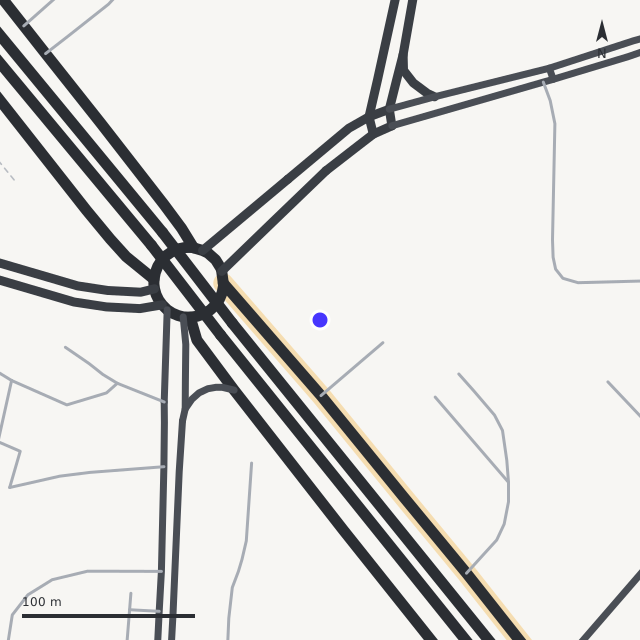
Road layout around the gate, drawn from OpenStreetMap
Road layout · drawn from OpenStreetMap · blue dot = school coordinate
FrontageThe gate opens onto an arterial road, on its NE side
Junctionthe gate area sits at a 3-leg junction
Street activity3 bus stops within 150 m (OpenStreetMap)
Crash recordcrash-location data is not yet available for Delhi — this line will be added when a public source lands
Exposure contextElevated — 52/100 (partial: no crash component yet). Describes how much traffic and crash risk passes this road — context only, never part of the road score (method: exposure v1, Data page)

Road layout data © OpenStreetMap contributors (ODbL), retrieved 13 Aug 2026 · crash data: Jaipur Police · derivations: `exposure_v1` on the Data page.

What we found · five checks · IRC:SP:32-2023

Five things we checked — and the photo behind each

Each check was read once, then verified blind by a second reader on a separate account. The photo each finding came from sits right beside it. Tap “see how this was judged” for the full reasoning.

✕
Slowing traffic downP1 · Physical speed control

Nothing slows traffic at the gate

No speed hump, table or rumble strip on the approach — vehicles reach the gate at full speed.

Absent
Also cited for this check
0 of 30 points
LevelNone (L0)
Points0 of 30
ConfidenceHigh
Coverage seen≈65%
VerificationConfirmed — both readers agreed
The full reasoning

No hump, table, rumble strip or other physical speed-control device visible on the frontage road or in the traverse views. Frontage surface is broken/dusty due to active metro construction rather than any calming device. Edges partly occluded by construction hoarding and parked vehicles.

◑
Getting across the roadP2 · Safe crossing

A marked crossing in the zone

A legible marked crossing is present in the school zone.

Partial⟳ Corrected in review
MinimalBasic

An independent second reader changed this — the two readings disagreed, and the evidence below settled it.

Also cited for this check
12.5 of 25 points
LevelBasic (L2)
Points12.5 of 25
ConfidenceMed
Coverage seen≈60%
VerificationCorrected in the second reading
The full reasoning

Reads differ (blind L2, audit L1). Decided from LlcNsr4MdtVo_h300, which shows a clearly painted, legible zebra crossing across the carriageway with a kerbed median refuge island at a downstream junction; PgkOkDlAN2oZ_h300 corroborates a median-divided junction in the same corridor. This junction is one of the in-zone traverse stations (zone span 150.5 m). The rubric L2 threshold is 'legible marked crossing in zone', which is satisfied. The audit's downgrade to L1 rested on the crossing being 'far from the gate' — but gate-proximity governs the L3 boundary (L2 + within 20 m of gate + refuge), which neither read awards, not the L1/L2 boundary. The audit's read fell. No crossing within ~20 m of the identified gate, so capped at L2. L2 does not require HIGH; a single crisp view keeps MED.

◑
Walking without stepping into trafficP3 · Footpath & separation

A broken walking edge

A walking edge exists but is broken or blocked for most of the frontage.

Partial
6.25 of 25 points
LevelMinimal (L1)
Points6.25 of 25
ConfidenceMed
Coverage seen≈60%
VerificationConfirmed — both readers agreed
The full reasoning

Arterial requires raised footpath. Paved/tiled footpath segments exist (interlocking pavers at kp1GvzNMt73S_h099; paved forecourt strip at the school frontage) but the walkable edge is broken and discontinuous along most of the frontage: metro-construction hoarding walls and dirt shoulders on one side, unpaved edge with informal-settlement encroachment on the other. Permanent/structural breaks, not just parked vehicles.

✕
Being seen and expectedP4 · Signage & zone identity

No school-zone signs

Drivers get no warning that a school gate is here.

Absent
0 of 10 points
LevelNone (L0)
Points0 of 10
ConfidenceMed
Coverage seen≈60%
VerificationConfirmed — both readers agreed
The full reasoning

No school-warning sign, speed-limit sign, carriageway speed stamp, or 2023-identity zone asset visible on either approach. Roadside signage is commercial (Bajaj showroom, real-estate hoardings). A rusted blank board near the frontage is illegible. Some occlusion from trees and hoardings.

◑
The gate itselfP5 · Gate environment

Space and a railing at the gate

A clear setback or railing gives room to gather off the carriageway.

Partial
5 of 10 points
LevelBasic (L2)
Points5 of 10
ConfidenceMed
Coverage seen≈50%
VerificationConfirmed — both readers agreed
The full reasoning

School frontage has a clear setback: a paved forecourt strip between the compound wall and carriageway (used for cycle parking) provides off-carriageway assembly space. No separate pedestrian opening, continuous gate-to-crossing rail, or marked pick-up/drop-off bay resolvable through roadside trees; gate opening itself not crisply visible, so capped at L2.

At the gate
On the frontage road
Along the street
Some captures sit on neighbouring lanes; older ones are shown greyed and were used only for context.
What must be fixed · 5 actions

What would make this road safe — and who owns each fix

Each action maps to a failing check, the relevant IRC:SP:32-2023 clause, and the responsible agency. Agency labels are provisional and correctable through the dispute channel.

01Lifts P1

Install a speed table or twin speed humps within 30 m of the gate

IRC:SP:32-2023 §5.13 · Table 5.1MCD / PWD · provisional

Speed humps near schools roughly halve child-pedestrian injury odds (Tester 2004); 30 km/h calmed zones ≈ 40% fewer casualties (Grundy 2009).

02Lifts P3

Provide a continuous clear walking edge on the school side

IRC:SP:32-2023 §5.4.1MCD / PWD · provisional

A continuous footpath keeps children off the carriageway on the approach, not only at the gate.

03Lifts P2

Mark a crossing within 20 m of the gate — table-top preferred

IRC:SP:32-2023 §5.4.3MCD / PWD · provisional

Raised crossings cut vehicle speeds at the exact conflict point.

04Lifts P4

School-zone warning signs on both approaches with the speed limit

IRC:SP:32-2023 §5.8MCD / PWD · provisional

The zone must announce itself to drivers before the gate.

05Lifts P5

Add space and a marked pick-up bay off the carriageway at the gate

IRC:SP:32-2023 §5.2MCD / PWD · provisional

Children should not step from the gate into a moving traffic lane.

Responsible-agency labels come from the CFI field instrument’s mapping and are correctable via the dispute channel.

Re-audit timeline

2026-08-06Audited
2027-02-06Re-audit due

Every published road is re-read every six months, or as soon as new Street View imagery lands, or on a sustained dispute.

Something wrong on this page?

The entrance, the imagery, a finding — if any of it is wrong, tell us. A dispute pauses this page while the audit is re-verified, and the correction is logged in the public record.

Dispute this audit